Master Promise Chaining and Error Handling for Robust Asynchronous JavaScript
Welcome to the Promise Chaining and Error Handling with Promises subcategory at LearnJavaScriptQuickly. Here, you’ll transform your understanding of asynchronous JavaScript by learning how to sequence multiple async operations gracefully, avoid callback hell, and build resilient code that fails predictably. Whether you’re fetching data, reading files, or orchestrating complex workflows, mastering promise chains and their error-capture patterns is essential for performance optimization and clean, maintainable code. Dive in to unlock practical techniques that will make your JavaScript applications faster, more reliable, and easier to debug.
🔗 Building Fluent Promise Chains for Sequential Async Operations
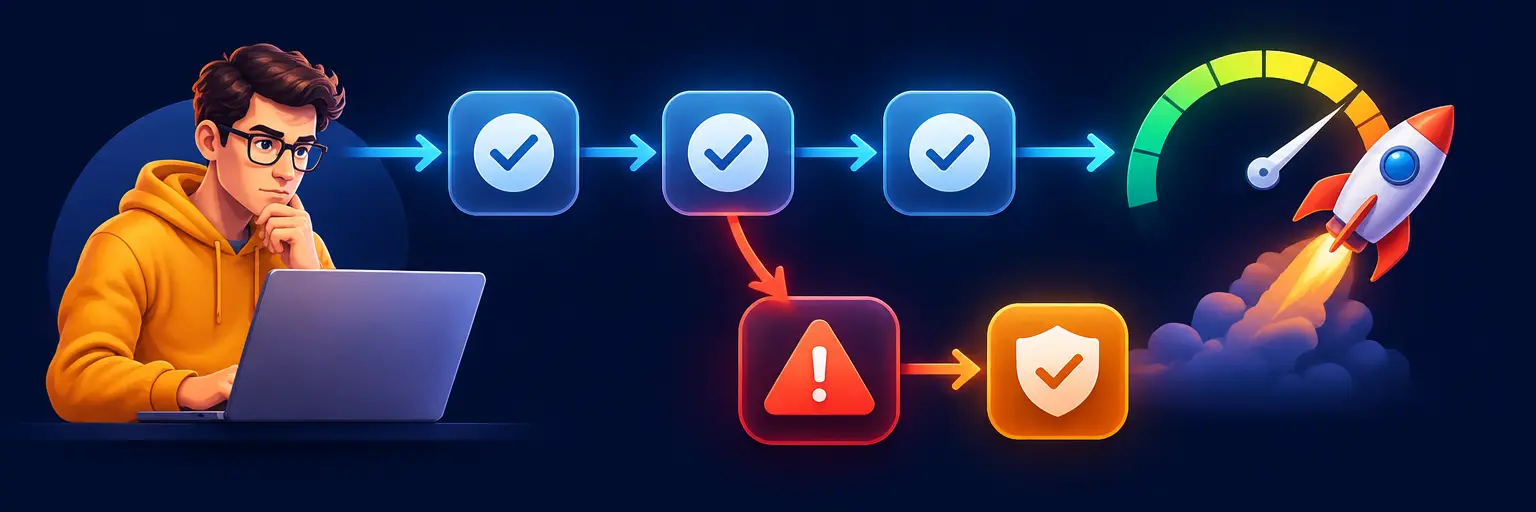
In this section, you’ll learn how to connect multiple promises using .then(), passing resolved values from one step to the next. This eliminates nested callbacks and creates a flat, readable sequence. Expect to practice chaining fetch calls, database queries, or file reads, and see how each .then() returns a new promise, allowing you to compose complex operations step by step. You’ll also discover how to handle intermediate steps, like transforming data or validating responses, without breaking the flow.
Beyond basic chaining, we’ll cover returning promises inside then to flatten deeper chains, and using Promise.resolve() to start a chain with a known value. You’ll see real-world examples, such as sequentially loading user data, then their posts, then comments, all with clear error separation. By the end, you’ll be able to write chains that are easy to read, easy to test, and easy to extend—crucial for any performance-sensitive application where ordering matters.
🛑 Comprehensive Error Handling with .catch() and .finally()
Error handling is where most async code breaks, so this section focuses on capturing failures at every stage of your chain. You’ll learn that a single .catch() at the end of the chain catches errors from any preceding .then(), but also how to insert inline catches for specific steps when you need finer control. We’ll demystify promise rejection propagation and show you how to avoid silent failures by always returning a rejected promise or throwing an error. Expect to practice both synchronous throws (inside then) and asynchronous rejections.
You’ll also master .finally() for cleanup tasks like hiding loading spinners or closing database connections, regardless of success or failure. This section highlights common pitfalls, such as forgetting to return a promise in a .then(), which causes errors to be swallowed. By the end, you’ll have a robust toolkit to ensure no error goes unhandled, making your asynchronous code production-ready and easier to debug under load.
⚡ Advanced Chaining Patterns: Promise.all, Promise.allSettled, and Promise.race
Moving beyond sequential chains, this section introduces parallel execution for performance optimization. You’ll learn when to use Promise.all to run independent tasks concurrently and wait for all to resolve—ideal for fetching multiple API endpoints at once. We’ll also cover Promise.allSettled, which waits for every promise to settle (either fulfilled or rejected) and returns an array of results, perfect for partial failures. Additionally, you’ll explore Promise.race for timeouts or first-response-wins scenarios.
Expect practical examples, like combining Promise.all with .map() to transform an array of IDs into fetched records, or using Promise.race to implement a 5-second timeout on a slow network request. You’ll understand the performance trade-offs and error semantics of each method, enabling you to choose the right pattern for your specific async workflow. These patterns are essential for optimizing user experience by reducing total wait time without sacrificing reliability.
🧩 Error Propagation and Recovery Strategies in Chains
Here, we dive deeper into how errors move through chained promises and how to recover gracefully. You’ll learn about catch-and-recover patterns, where a .catch() returns a fallback value, allowing the chain to continue instead of breaking completely—a common need for default data or caching. We’ll also cover error branching with single vs. multiple catches and how to rethrow errors to maintain rejection for higher-level handlers. Expect to simulate scenarios like network flakiness, malformed JSON, or authentication failures.
You’ll also discover how to use custom error classes to differentiate between error types (e.g., validation vs. server error) and route them to appropriate recovery logic. This section emphasizes defensive coding: always assume a step can fail, and design your chain to handle it. With these strategies, your code becomes more resilient, user-friendly, and easier to monitor—critical for any asynchronous application aiming for high performance and stability.
🚀 Real-World Projects: Building an Async Data Pipeline
Finally, you’ll apply everything by creating a complete data pipeline, such as a user dashboard that fetches profile, posts, and comments sequentially, then processes them in parallel. This project-based section walks you through step-by-step implementation, from initial promise chain design to adding robust error handling with retries for failed fetches. You’ll also learn to integrate async/await as a syntactic sugar over promise chains, comparing both styles for readability and debugging.
We’ll include performance tips like early error short-circuiting and caching resolved promises to avoid redundant network calls. By the end, you’ll have a portfolio-ready example that demonstrates your mastery of promise chaining and error handling. This hands-on approach ensures you not only understand concepts but can build scalable, optimized async flows that are essential for modern JavaScript applications, from Node.js backends to frontend single-page apps.
Frequently Asked Questions
What is the difference between .then() chaining and async/await for error handling?
Both handle errors, but async/await uses try/catch blocks, which are often more readable for linear code. Promise chaining uses .catch() methods. Async/await can make chains look synchronous, but chaining offers more flexibility for complex branching. For simple sequential steps, either works; for parallel or conditional logic, chains with Promise.all are often clearer. Choose based on your team’s style and the complexity of error recovery needed.
How do I catch errors from multiple promises in Promise.all?
If any promise inside Promise.all rejects, the entire Promise.all rejects immediately, and you can catch it with a single .catch() at the end. However, if you need errors from individual promises, use Promise.allSettled(), which returns an array of statuses and reasons, allowing you to handle each error separately without short-circuiting the rest.
Why does my .catch() sometimes not execute in a promise chain?
This usually happens when you forget to return a promise inside a .then() callback. If you don’t return, the chain continues with a resolved value (undefined), so errors from a later step won’t be caught by an earlier .catch(). Always ensure every .then() returns a promise or throws an error to propagate rejection correctly.
Can I use multiple .catch() methods in one chain for different errors?
Yes, you can place multiple .catch() methods at different points, but note they only catch errors from steps that occur before them. For example, a .catch() after the first .then() catches that step’s errors, but later steps need their own catches. Alternatively, use a single final .catch() and inspect the error type to route recovery logic.
What is the best practice for handling errors in a chained promise that must always continue?
Use a .catch() that returns a fallback value (like null or an empty object) to keep the chain alive. For more complex recovery, wrap each vulnerable step in its own .then() with an inline .catch() that returns a safe default. Also consider logging the error for diagnostics. This ensures the flow never breaks and you maintain visibility into failures.