Understanding JavaScript Jargon and Terminology for Newcomers
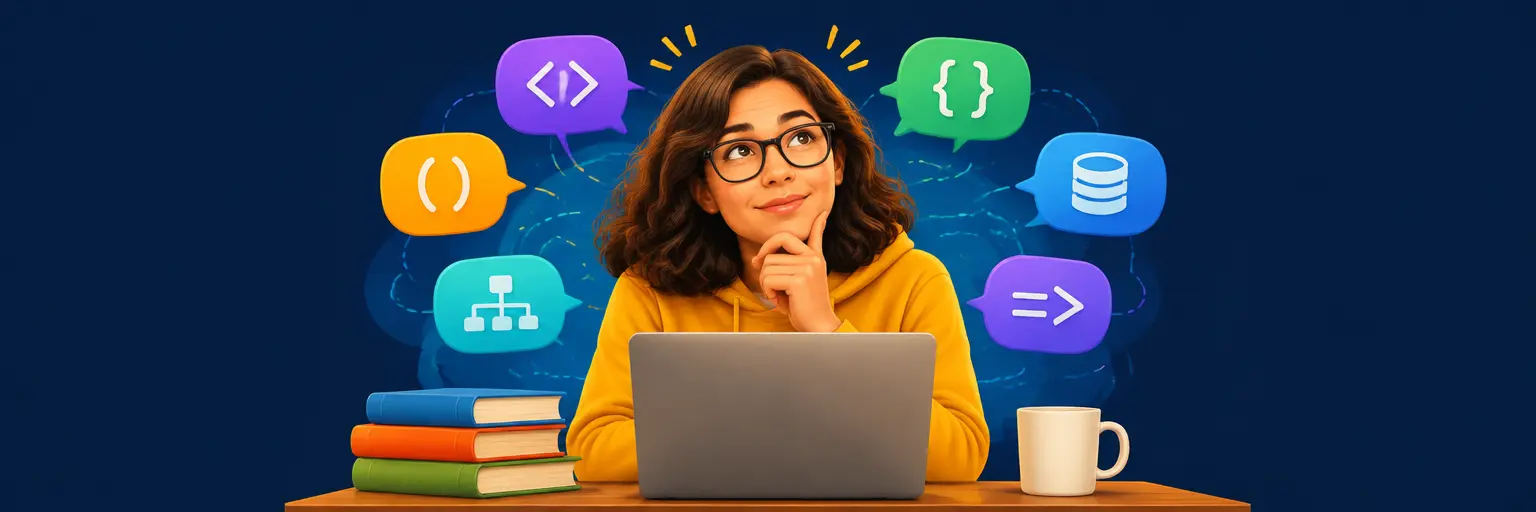
Welcome to the essential glossary hub of LearnJavaScriptQuickly, where we decode the intimidating vocabulary of JavaScript so you can code with confidence. This subcategory is your friendly translator, turning complex terms like "callbacks," "closures," and "event loops" into clear, practical concepts. Whether you’re just starting your first script or brushing up before a job interview, these plain-English explanations, paired with real-world examples, will make you feel at home in the JavaScript ecosystem. Let’s strip away the mystery and build your technical fluency step by step.
🔤 Core Syntax Terms: Variables, Functions, and Operators
In this section, we demystify the bread-and-butter words you’ll see daily: variables (let, const, var), functions (declarations vs. expressions), and operators (arithmetic, logical, comparison). You’ll learn why scope matters and how hoisting can surprise you. We avoid math-heavy jargon and focus on intuitive analogies—like comparing a variable to a labeled box—so you can immediately apply these terms while writing your first lines of code.
Expect quick-reference tables and mini-code snippets that illustrate each term in action. For example, we’ll break down the difference between mutable and immutable data, and why strict equality (===) beats loose equality (==) in modern practice. By the end, you’ll not only repeat these terms correctly but also know when to use them, boosting your ability to read documentation and follow tutorials without getting stuck on basic vocabulary.
🧠 Data Structures & Types: Arrays, Objects, and Primitives
Here, we crack open the world of data types—strings, numbers, booleans, null, undefined, and symbols—along with complex structures like arrays and objects. You’ll understand why JavaScript is dynamically typed and what that means for your coding habits. We also demystify type coercion, the sneaky automatic conversion that can cause bugs, and show you how to tell if a variable is an array using Array.isArray().
This section is packed with practical metaphors: think of an array as a numbered list and an object as a labeled filing cabinet. We explain indexing, key-value pairs, and iteration methods like forEach and map in plain language. You’ll leave knowing exactly what a prototype is (not as scary as it sounds) and why objects are the backbone of JavaScript’s flexibility. Perfect for beginners who want to avoid common confusion between “array” and “object” when reading code.
⚙️ Control Flow & Logic: Loops, Conditionals, and Truthy/Falsy
Master the language of decision-making with conditionals (if, else, switch) and loops (for, while, do-while). We break down the concept of truthy and falsy values—like why 0 is false but "0" is true—and how this affects conditional statements. You’ll also learn about short-circuit evaluation with logical operators (&&, ||) as a neat trick to write cleaner code.
We use everyday scenarios—like deciding whether to wear a coat based on temperature—to explain flow control. You’ll practice tracing code paths and predicting outputs, which builds the debugging mindset essential for real projects. Additionally, we cover break and continue statements inside loops, so you know how to exit early or skip an iteration without panic. This foundation will make complex algorithms feel approachable later on.
🌐 Functions & Scope: Closures, Callbacks, and the “this” King
Dive into the heart of JavaScript’s power: first-class functions that can be treated like any other value. We clarify callbacks (functions passed to other functions) and closures (functions remembering their outer scope), two terms that often confuse beginners. You’ll see how these concepts drive event handling, array methods, and asynchronous code without needing a CS degree.
The dreaded this keyword gets special attention—we explain its behavior in different contexts: global, object methods, arrow functions, and events. We also touch on higher-order functions (functions that return or accept functions) and IIFEs (immediately invoked function expressions) with simple analogies. By the end, you’ll be able to read code with nested functions and predict how lexical scoping affects your variables, making you feel like you truly “get” JavaScript’s quirky side.
🚀 Asynchronous Basics: Promises, Async/Await, and the Event Loop
Unlock the mystery of asynchronous programming—the reason animations don’t freeze your page. We simplify the event loop as a queue system at a coffee shop: main thread serves orders, callbacks wait for completion. You’ll learn about promises as IOUs for future values, with methods like .then() and .catch(). Then, we show how async/await makes promise code read like synchronous logic, reducing mental overhead.
This section also explains microtasks vs. macrotasks in plain terms, so you know why a setTimeout might run after a promise. We include practical examples like fetching data from an API and error handling with try/catch. By understanding these terms, you’ll be ready to tackle AJAX calls, node.js backends, and modern frameworks without fear. It’s the final linguistic puzzle piece that transforms you from a dabbler into a coder who can speak fluent JavaScript.
Frequently Asked Questions
What is the difference between `let` and `const` in JavaScript?
Both are used to declare variables, but let allows reassignment, while const creates a read-only binding once initialized. However, const objects and arrays can still be mutated (e.g., pushing to an array). Use const by default; switch to let when you need to reassign the variable’s value.
Why is “undefined” different from “null” in JavaScript?
Undefined means a variable has been declared but has no assigned value—it’s the default state. Null is an intentional assignment to represent “no value” or empty. In comparisons, undefined == null is true, but undefined === null is false because they are different types.
What exactly is a closure, and why should beginners care?
A closure is a function that retains access to variables from its outer (enclosing) scope even after that outer function has finished executing. You’ll see closures in callbacks, event handlers, and factory functions. They enable encapsulation and private-like variables, making your code modular and data-safe.
How does the event loop work in JavaScript?
JavaScript runs on a single thread. The event loop monitors a call stack and a message queue. When the stack is empty, it takes the first task from the queue (e.g., a setTimeout callback) and runs it. Promises, however, go to a microtask queue that gets processed before the next macrotask, giving async code a priority boost.
What is a promise in simple terms, and how do I use one?
A promise is an object representing the eventual success (resolve) or failure (reject) of an asynchronous operation. You attach .then() to handle success and .catch() for errors. For example, fetch('/api') returns a promise; you chain .then(res => res.json()) to parse the response. Async/await is syntactic sugar on top of promises, making code look linear.