From Netscape to Node.js: Tracing JavaScript's Journey
😊 Explore JavaScript's fascinating evolution! This beginner tutorial traces its journey from Netscape's early days to the modern Node.js era, offering a…
Read article
JavaScript didn’t just appear out of thin air—it was born in just 10 days at Netscape in 1995, evolving from a simple form-validator into the most widely used programming language on the planet. This journey takes you from its chaotic early days of browser wars and “Java” branding, through the standardization efforts of ECMAScript, to the game-changing ES6 revolution that introduced arrow functions, classes, and modules. Understanding this history isn’t just a trip down memory lane—it helps you grasp *why* modern JavaScript works the way it does, why you use const over var, and how past decisions shape today’s best practices. Whether you’re debugging legacy code or starting fresh with modern frameworks, knowing the timeline from Mocha to ES2024 and beyond gives you a powerful mental map. Dive into this quick, engaging chronicle and see how a struggling scripting language conquered the web, mobile, and even server-side with Node.js. Perfect for absolute beginners and curious coders alike, this is your fast-track to appreciating the craft behind every line of JavaScript you write today.
Welcome to our dedicated subcategory on the history of JavaScript, where we trace the language’s journey from its humble beginnings at Netscape to the modern era of ES6 and beyond. Understanding this evolution is crucial for any developer—it explains why JavaScript behaves the way it does, why certain features exist, and how past decisions shape today’s best practices. Here, you’ll find clear, beginner-friendly explanations, timeline breakdowns, and insights into each major milestone, all tailored to help you grasp the why behind the code.
JavaScript was created in just 10 days by Brendan Eich in 1995 while he was working at Netscape. Initially named Mocha, then LiveScript, it was quickly renamed to JavaScript to ride the wave of Java’s popularity. The language was designed to add interactivity to static HTML pages, enabling client-side form validation, dynamic content updates, and simple animations. This section breaks down the original constraints, the competitive browser wars, and how JavaScript’s prototype-based object model set it apart from Java—a key insight for learners who often confuse the two.
Expect to learn about the first version of ECMAScript (ES1) in 1997, which standardized the language to prevent fragmentation across browsers. We’ll also cover the infamous “Browser Wars” where Netscape and Microsoft’s Internet Explorer competed fiercely, leading to inconsistent implementations. By understanding this period, you’ll appreciate why modern tools like transpilers and polyfills exist—to smooth over legacy quirks that still linger in some codebases today.
After the initial boom, JavaScript faced a stagnation period from 2000 to 2008. ECMAScript 4 was abandoned due to political disagreements among committee members, leaving ES3 as the standard for nearly a decade. Meanwhile, developers battled with inconsistent browser behaviors, lack of built-in modules, and painful cross-browser debugging. This era saw the rise of workarounds like the XMLHttpRequest for AJAX, which quietly laid the foundation for Web 2.0, but the language itself remained static and limited in features.
In this subcategory, we explore how libraries like jQuery and Prototype emerged to abstract away these inconsistencies, making JavaScript usable for the masses. You’ll also see how Google Chrome’s V8 engine in 2008 changed everything—speeding up execution and implicitly pushing for a language upgrade. This period is vital for understanding why many older codebases still use var, callbacks, and other legacy patterns, and why modern best practices evolved as a reaction to these pain points.
ES5, released in 2009, was a game-changer—it added support for JSON, strict mode, array methods like forEach and map, and object property descriptors. But the real momentum came from the community’s push for a richer language. This section details how ECMAScript 6 (ES6), also known as ECMAScript 2015, was developed over years of open discussions, incorporating feedback from developers and transpilers like Babel that let you use future syntax today. You’ll learn about the dramatic shift from var to let and const, the introduction of arrow functions, classes, template literals, destructuring, and modules.
We’ll also cover the yearly release cycle that began after ES6, meaning new features now arrive annually. You’ll see how this regular cadence transformed JavaScript from a language that changed once a decade to one that evolves continuously. For learners, this part highlights why modern tutorials often reference ES6+ syntax as the baseline, and how understanding the evolution helps you read old code and migrate it gracefully.
Since ES6, JavaScript has added a torrent of powerful features: promises and async/await for cleaner asynchronous code, destructuring, spread operators, Optional chaining, nullish coalescing, and more. This subcategory zeroes in on the most impactful post-ES6 additions, explaining how they simplify complex tasks and improve code readability. We also cover the rise of TypeScript—a typed superset—and how it addresses JavaScript’s weaknesses while remaining fully compatible.
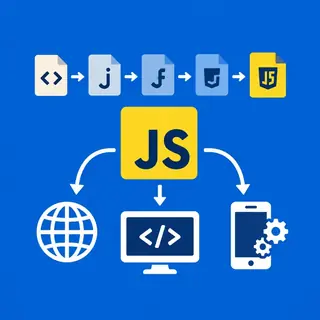
Expect to see practical examples of how modern features solve real-world problems, from handling API calls to managing state in frameworks like React or Vue. We discuss how Node.js brought JavaScript to the server, and how tools like npm and webpack created a thriving ecosystem. By the end, you’ll not only know the history but also why the language is now a universal choice for full-stack development, desktop apps via Electron, and even embedded systems.
JavaScript’s future is bright, with proposals in various stages via the TC39 committee. We highlight upcoming features like decorators, private class fields (already shipped), record & tuple types, and temporal for better date handling. You’ll understand how the “stage” process works—from proposal to acceptance—and why community feedback matters. We also explore emerging trends like WebAssembly, which complements JavaScript for performance-critical tasks.
This section helps you future-proof your learning: by knowing the direction of the language, you can invest in skills that will remain relevant. We’ll discuss how JavaScript’s standard library is growing, how build tools are getting faster, and how artificial intelligence might assist coding. While we can’t predict everything, we’ll give you a roadmap of what to watch for, ensuring you stay ahead as a developer.
JavaScript was named for marketing reasons—Java was hugely popular in 1995, and Netscape wanted to capitalize on that buzz. The languages are fundamentally different: Java is class-based and compiled, while JavaScript is prototype-based and interpreted. The name stuck, but it’s purely a branding decision, not a technical one.
ES6 introduced major syntax improvements: let/const for block-scoped variables, arrow functions, classes, template literals, destructuring, and modules. ES5 only had var and function-based patterns. Beginners should start with ES6 because it’s the modern standard, but learning ES5 helps you read legacy code. Focus on ES6 for new projects.
No, but it helps you understand why certain patterns exist and why some code uses var or callbacks. History also explains browser compatibility issues and why transpilers like Babel matter. For practical coding, you can write modern ES6+ without knowing history, but the context makes you a better problem-solver.
The release of ES6 in 2015 is widely considered the biggest pivot—it added dozens of features that made the language much more expressive and beginner-friendly. Before ES6, JavaScript was harder to write and read; after, it became a robust, modern language suitable for large-scale applications.
Yes, JavaScript updates yearly with small, incremental improvements via the TC39 process. You don’t need to learn everything immediately, but staying aware of major additions like optional chaining or async/await helps you write cleaner code. Follow reliable sources and practice new features as they reach stage 4 (finalized).