Optimizing JavaScript Game AI: Tips and Tricks for Better Performance
😊 Level up your JavaScript games! This article delivers practical tips and tricks to optimize JavaScript game AI performance, boosting responsiveness and…
Read article
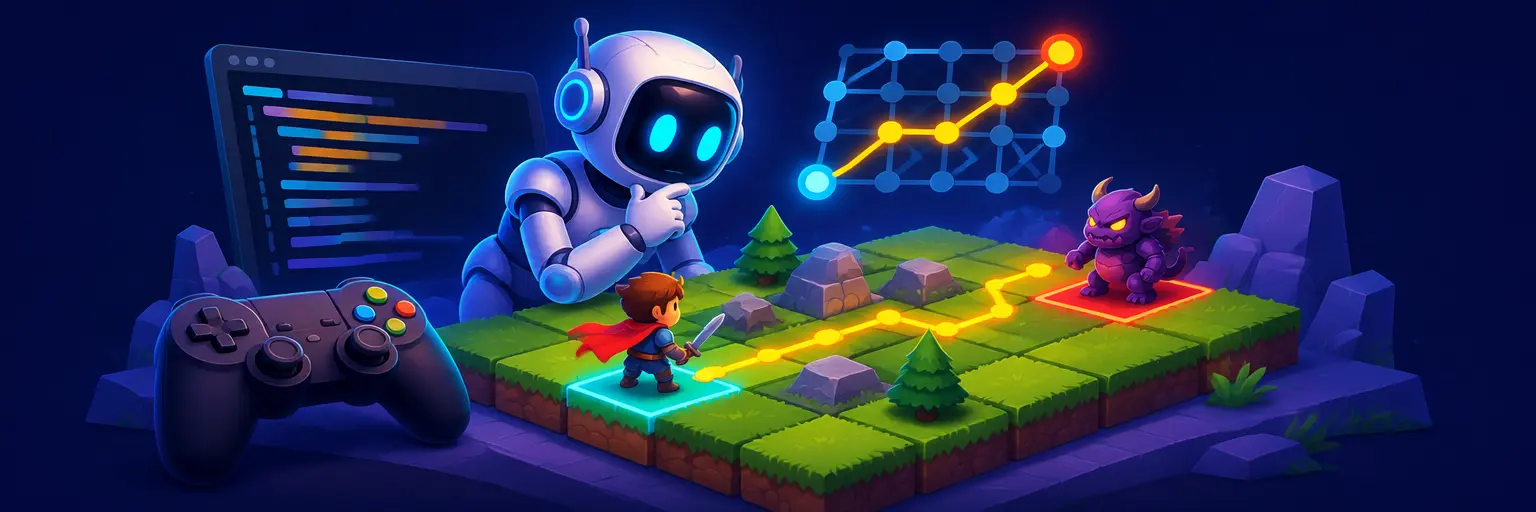
Master advanced JavaScript game mechanics by unlocking the secrets of AI and pathfinding—the engines that bring your web games to life. Dive into practical, step-by-step tutorials designed for beginners and intermediate coders alike, where you’ll learn to build intelligent enemies, simulate decision-making, and implement smooth navigation using algorithms like BFS, Dijkstra, and A*. From chasing player avatars to plotting obstacle-avoiding routes, these hands-on lessons turn complex concepts into fun, mini-projects you can play immediately. Perfect for JavaScript learners who want to level up from static scenes to dynamic, living worlds—without getting lost in theory. Start coding smarter, not harder, and watch your games respond with real-time strategy. 🎮🤖✨

😊 Level up your JavaScript games! This article delivers practical tips and tricks to optimize JavaScript game AI performance, boosting responsiveness and…
Read article
🤔 Master JavaScript game AI with our guide on finite state machines! Learn how to create intelligent, responsive game characters using this…
Read article
🤔 Level up your JavaScript game development skills! This tutorial shows you how to build an AI opponent that learns and adapts,…
Read articleWelcome to the Advanced Game Mechanics in JavaScript subcategory, where you’ll transform basic browser games into intelligent, living worlds. Here, we focus on the AI and pathfinding techniques that power everything from enemy patrols to NPC navigation in mini-projects. Whether you’re building a maze solver, a tower defense, or a platformer with smart adversaries, this page is your gateway to JavaScript game AI, pathfinding algorithms, and state machines. Expect practical, code-first tutorials that build on your existing JavaScript knowledge, with a strong emphasis on performance and real-time interaction.
Dive into the essentials of behavior trees and finite state machines (FSMs) to create enemies that react intelligently—patrolling, chasing, and retreating. You’ll learn how to structure your JavaScript code with clear states like idle, alert, and attack, making your games feel polished and unpredictable. Expect step-by-step examples using canvas and requestAnimationFrame, with reusable patterns for any mini-project. We emphasize modular design so you can easily expand your AI without rewiring your entire game loop.
Beyond simple if-else logic, this section shows you how to prioritize actions—like detecting the player first, then deciding between chase or flee. You’ll also tackle utility-based AI for more complex decisions, such as selecting the best cover spot or (in the context of pathfinding) deciding when to recalculate a route. By the end, you’ll have a library of AI “brains” you can plug into your own arcade games, with clear comments and performance tips for mobile-friendly browsers.
Learn to implement the A* (A-Star) algorithm from scratch in JavaScript, the gold standard for grid-based pathfinding in games. This section covers heuristic functions (Manhattan, Euclidean), open/closed sets, and neighbor generation, all optimized for 2D maps. You’ll see how to adapt A* for obstacles, weighted terrain, and dynamic changes—like doors opening mid-game. Each tutorial includes a live demo you can play with, plus a walkthrough of the code’s time complexity and how to avoid common pitfalls like infinite loops.
We also introduce BFS (Breadth-First Search) and Dijkstra’s algorithm as simpler alternatives for small maps or when uniform costs apply. You’ll learn when to use which, and how to store paths as arrays of coordinates for smooth character movement. Practical mini-projects include a “ghost chase” in Pac-Man style and a tower defense where units reroute around newly placed towers. Performance bottlenecks are highlighted, with tips on precomputing static maps and using binary heaps for faster sorting.
Take your AI beyond grid tiles with steering behaviors—seek, flee, arrival, wander, and pursuit—ideal for free-moving entities in canvas games. You’ll implement these using vector math in JavaScript, combining multiple forces for organic movement around walls and other agents. This section focuses on collision avoidance and flow fields, allowing enemies to navigate open spaces without jittering. We cover how to blend steering with A* for hybrid approaches, giving you the best of both grid precision and natural motion.
Expect real-world examples like a flocking simulation for bird enemies or a “follow the leader” convoy. You’ll also learn to handle dynamic obstacles and moving targets, crucial for boss fights or chase sequences. Code is heavily commented, and we include a debug drawing mode to visualize vectors, predicting paths, and avoidance radii. This makes it easy to tweak parameters like max force and slowing radius until your AI feels perfectly tuned for your game’s speed.
Running AI on every frame can cripple your game’s performance. This section teaches you frame-rate-independent AI updates and coroutine-style computation to spread pathfinding over multiple frames. You’ll master spatial partitioning using grids or quadtrees to reduce collision checks, and learn to cache path results for static environments. We also dive into object pooling for AI agents and path nodes, minimizing garbage collection pauses. All techniques are tested on low-end devices, with benchmarks provided.
We cover visibility graphs and navmesh generation as pro-level alternatives to grid A*, ideal for games with irregular geometry. You’ll see how to precompute navigation data at load time and update only local regions when the environment changes. Additionally, we discuss multithreading via Web Workers for heavy path searches, ensuring your game stays responsive while the AI thinks. These optimization strategies are crucial for making your mini-projects run smoothly on desktop and mobile alike.
Put everything together by constructing a full mini-game—a “Robot Escape” where AI guards patrol, chase, and call for backup using all the mechanics you’ve learned. This project walks you through the game state management, spawning enemies with different AI profiles, and integrating pathfinding with steering for seamless movement. You’ll also implement a simple difficulty system that adjusts AI speed and reaction time based on player score. The final code is structured for easy reuse, with separate modules for AI, pathfinding, and rendering.
Through this hands-on project, you’ll solidify your understanding of how systems interact—like how a guard’s state changes when it loses sight of the player, or how to debug a path that suddenly becomes blocked. We also include a section on testing and tuning, with checklist items to ensure your AI is fair and fun. By the end, you’ll have a portfolio-ready game that demonstrates advanced JavaScript AI, perfect for sharing on CodePen or GitHub. It’s the ultimate capstone for this subcategory.
For most small 2D games, A* with a Manhattan heuristic is ideal because it’s fast and memory-efficient on grids under 100×100. Use BFS if all tiles have equal cost and you need shortest paths, or Dijkstra if you have weighted tiles. Start with A* and optimize later using binary heaps for the open set—it’s a proven choice for JavaScript mini-projects.
Basic vector math—addition, subtraction, normalization, and dot products—is sufficient for 90% of steering behaviors. We provide a small Vector helper class in our tutorials, so you don’t need a math degree. As long as you understand how to scale and add forces, you can implement seek, flee, and pursuit without fear.
Three strategies work best: precompute paths for static obstacles, limit how often you recalculate (e.g., every 0.5 seconds), and offload heavy searches to a Web Worker. Also, use a coarse grid (e.g., 32×32 tiles) for pathfinding, then smooth the path for movement. Caching paths for multiple agents moving to the same target also helps.
State machines are simpler for beginners and perfect for 3–5 states like idle, chase, attack. Behavior trees shine when you have complex, hierarchical decisions or want to reuse sub-behaviors across multiple enemies. Start with a finite state machine for your first games; upgrade to behavior trees if you find states overlapping or hard to manage.
Yes, and it’s actually recommended. Use A* to generate a coarse path, then apply steering forces to follow that path, adding obstacle avoidance forces on top. This gives you grid-level efficiency and natural movement. Just ensure your steering force is strong enough to overcome path deviation but weak enough to avoid cutting corners through walls.