Mastering Real-Time Communication with WebSockets: Advanced Concepts
Welcome to Real-time Communication with WebSockets – Advanced Concepts, part of the APIs, AJAX & Web Application Development category at LearnJavaScriptQuickly. This subcategory is designed for developers who already understand basic WebSocket usage and want to elevate their skills to production-grade, scalable, and secure real-time applications. Here, you’ll dive deep into protocol nuances, performance optimization, error handling, and architectural patterns that power modern chat apps, live dashboards, collaborative tools, and multiplayer games. Expect hands-on JavaScript tutorials with practical code snippets, best practices, and pitfalls to avoid—all geared toward making you a confident real-time developer.
🔌 WebSocket Protocol Deep Dive: Frames, Ping/Pong, and Subprotocols
In this section, you’ll move beyond simple send() and onmessage to understand the underlying frames that make WebSockets efficient. You’ll learn how to handle binary vs. text messages, fragmentation for large payloads, and control frames like ping/pong for keep-alive health checks. We’ll explore how to negotiate custom subprotocols (e.g., MQTT over WebSockets) and why they matter for structured communication.
Expect practical tutorials on implementing a heartbeat mechanism to detect dead connections, which is crucial for mobile networks and load balancers. You’ll also see how to parse and construct WebSocket frames manually, enabling you to debug network traffic confidently. By mastering these low-level details, you’ll prevent memory leaks and maintain stable connections, even under high concurrency.
⚡ Scaling Real-Time Apps: Clustering, Redis Pub/Sub, and Horizontal Scaling
Scaling WebSockets horizontally is tricky because connections are stateful and tied to a specific server instance. Here, we’ll tackle sticky sessions, load balancer configuration (like using ip_hash), and the critical role of Redis Pub/Sub for broadcasting messages across multiple Node.js processes. You’ll learn how to avoid stale connection issues and ensure that a message sent to one server reaches all subscribers.
We’ll walk through a complete pattern: each WebSocket server subscribes to a Redis channel, and any incoming message is published there, then relayed to all connected clients via their local WebSocket. This approach scales seamlessly from one to dozens of instances. You’ll also explore alternatives like using a message broker (RabbitMQ) and the trade-offs of in-memory vs. distributed caches. Expect code examples for socket.io-redis and raw ws with Redis.
🛡️ Security Hardening: Authentication, Authorization, and Input Validation
WebSocket connections bypass traditional HTTP headers after the initial handshake, so you must secure them differently. This section focuses on token-based authentication (JWT) passed during the upgrade request, validating origin headers to prevent cross-site WebSocket hijacking, and using a per-message authentication pattern for granular access control. You’ll learn to encrypt all traffic via WSS (TLS) and how to handle reconnection without exposing secrets.
We also cover input validation for every incoming message, rate limiting to prevent brute-force or spam attacks, and the dangers of client-controlled user IDs. Through guided exercises, you’ll implement a secure chat room where users can only join authorized channels. Emojis and rich text are sanitized to prevent XSS via WebSocket-driven DOM injection. This knowledge is essential for any production-ready real-time feature.
🔄 Advanced Error Handling and Reconnection Strategies
Network failures, server restarts, and proxy timeouts are inevitable in real-world apps. This module teaches you robust reconnection logic with exponential backoff, random jitter, and limited retries to avoid a thundering herd. You’ll learn how to detect stale connections using heartbeat intervals and gracefully close them. We also discuss idempotent message delivery—how to retry sends without duplicating effects—and storing unsent messages locally.
You’ll implement a client-side state machine (connecting, open, closing, closed) and automatically resubscribe to channels on reconnect. We’ll cover server-side handling of abrupt disconnects, cleaning up resources, and notifying other clients of presence changes. Real-world case studies include a live trading dashboard that resumes missed data production. By the end, your apps will handle flaky networks like a professional.
📊 Performance Monitoring and Profiling WebSocket Connections
Once your app is live, you need to measure its health. This section introduces tools like ws-stats, Node.js process.memoryUsage(), and custom metrics for messages per second, active connections, and round-trip latency. You’ll learn how to use Chrome DevTools’ network panel for WebSocket frames and how to integrate with monitoring services like Prometheus and Grafana for real-time dashboards.
We also cover debugging common performance bottlenecks: CPU-bound message serialization, backpressure handling when clients are slower than producers, and memory leaks from retained closures. You’ll practice benchmarking different payload sizes and compression algorithms (like permessage-deflate) to reduce bandwidth. Practical labs include stress-testing with autocannon and observing garbage collection behavior to keep your app smooth under load.
Frequently Asked Questions
How is WebSocket different from AJAX or long polling?
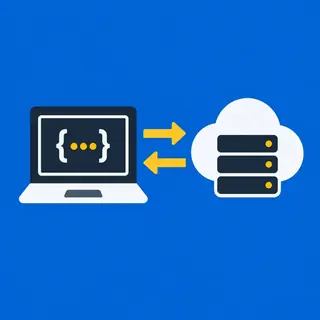
WebSocket creates a single, persistent, full-duplex connection after the initial handshake, allowing both client and server to push messages anytime with low latency. AJAX (XHR/fetch) is request-response only—the server cannot initiate data. Long polling emulates push by keeping the request open, but it still requires new HTTP connections repeatedly. WebSocket reduces overhead, achieves near-instant delivery, and is ideal for real-time apps.
Can I use WebSockets with authentication tokens?
Yes, best practice is to send the token as a query parameter or HTTP header during the WebSocket upgrade request (the initial HTTP GET). The server validates it before accepting the upgrade. After that, you can also embed user ID in each message. Avoid storing tokens in URLs for logging safety; use a short-lived token and refresh via a separate HTTP call near expiry.
What happens if a WebSocket connection drops?
Both client and server detect the drop via close frames or failed ping/pong responses. The client then attempts to reconnect using exponential backoff (e.g., 1s, 2s, 4s) with jitter. On reconnect, the client must resubscribe to channels and sync missed messages, if any were sent during downtime. Proper recovery ensures no data loss for critical apps.
How do I broadcast a message to all connected clients efficiently?
Within a single server process, you can iterate over all clients and call send(). For multiple server instances, use a pub/sub system like Redis: publish the message to a channel, every server subscribes and relays it to its local clients. This decouples servers and scales linearly.
Is WebSocket secure enough for financial or healthcare data?
Yes, if you use secure WebSocket (WSS) which encrypts all traffic via TLS, similar to HTTPS. Additionally, enforce strong authentication, authorization, input validation, and rate limiting. Always assume messages can be tampered with—validated every payload. For extra security, use end-to-end encryption at the application level for sensitive content.