NoSQL Data Security in JavaScript: Protecting Sensitive Data
🤔 Secure your JavaScript applications using NoSQL databases! This tutorial tackles JavaScript NoSQL database security, guiding you through essential practices to protect…
Read article
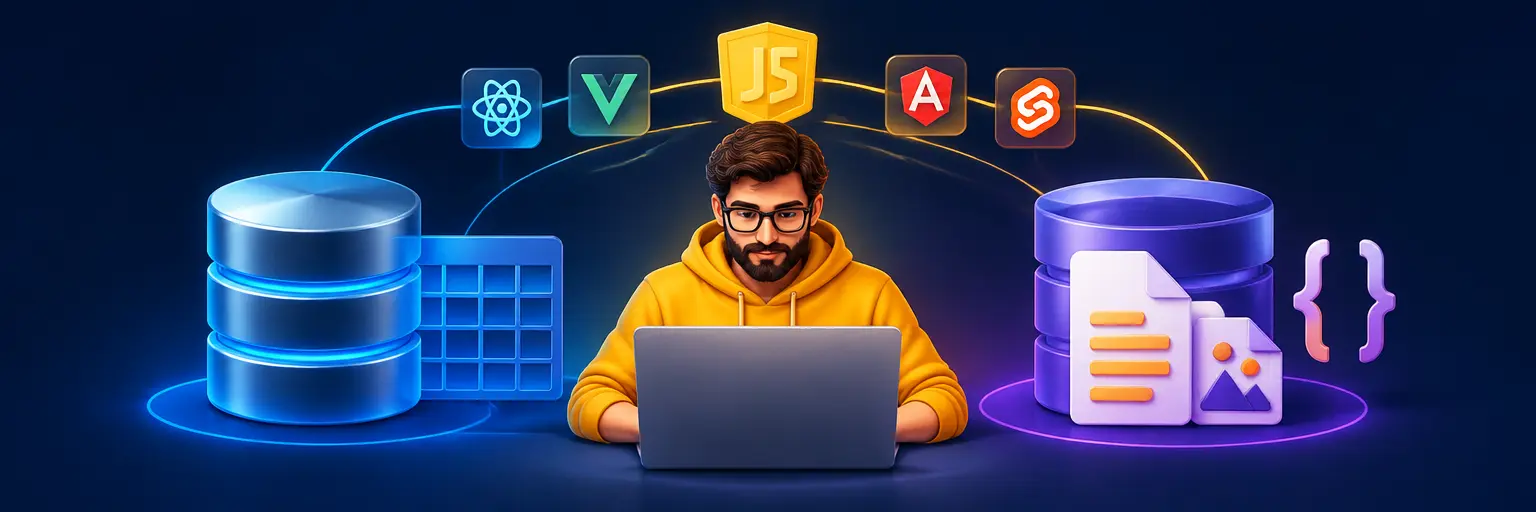
Unlock the full potential of your full-stack JavaScript projects by mastering the data layer that powers modern apps. In this deep dive, we demystify both NoSQL and SQL databases, giving you the practical skills to choose, design, and query the right storage solution for any scenario. Whether you’re building real-time apps with MongoDB and Firebase, or need the reliability of PostgreSQL and MySQL, this guide bridges the gap between theory and hands-on implementation. You’ll learn how to integrate databases seamlessly with Node.js and Express, write efficient queries, model data for performance, and avoid common pitfalls—all through step-by-step examples and real-world projects. Perfect for beginners and intermediate developers, this resource ensures you don’t just *know* database concepts but can confidently apply them in your JavaScript stack. Accelerate your learning, boost your resume, and build data-driven applications that scale. Dive in now to transform your coding journey with durable, actionable database expertise.
🤔 Secure your JavaScript applications using NoSQL databases! This tutorial tackles JavaScript NoSQL database security, guiding you through essential practices to protect…
Read article
🤔 Master database interactions with our JavaScript SQL transaction tutorial! Learn how to ensure data consistency using SQL transactions within your JavaScript…
Read article
🤔 Unlock JavaScript's speed potential! Learn how strategic SQL indexing dramatically improves database query performance, directly optimizing JavaScript applications that rely on…
Read articleWelcome to your comprehensive guide on database technologies for full-stack JavaScript! Whether you’re building a real-time chat app or a robust e-commerce platform, understanding both NoSQL and SQL databases is essential for modern development. This subcategory is designed to help you master data persistence, querying, and integration with Node.js, Express, and React—all through hands-on examples tailored for beginners and intermediate learners on LearnJavaScriptQuickly. 🚀
In this section, you’ll dive into MongoDB, the most popular NoSQL database for JavaScript developers. We’ll explore how document-oriented storage works, why it’s schema-flexible, and how it integrates seamlessly with JavaScript objects. You’ll learn to perform CRUD operations using Mongoose, a powerful ODM that simplifies data modeling. Expect step-by-step tutorials on connecting MongoDB to your Express server, handling embedded documents, and using aggregation pipelines for complex queries. This knowledge is crucial for building scalable, modern apps where data structures evolve quickly.
By mastering NoSQL, you’ll gain the ability to handle unstructured or rapidly changing data, like user profiles, social media feeds, and IoT sensor outputs. We’ll also cover performance optimization, indexing, and best practices for data validation, ensuring your applications remain fast and reliable. Whether you’re a visual learner or prefer hands-on coding, our practical examples will help you build real-world projects, such as a task manager or a blog platform, with confidence. 🛠️
Here, we focus on PostgreSQL, a robust, open-source SQL database that excels in relational data management. You’ll learn the fundamentals of tables, primary and foreign keys, and normalized schemas, essential for transactional applications like banking or inventory systems. Through clear, concise tutorials, you’ll write complex SQL queries using joins, subqueries, and window functions, and integrate them with Node.js using libraries like pg or Sequelize ORM. This section emphasizes data integrity, ACID compliance, and how to model relationships effectively—skills that distinguish professional full-stack developers.
We’ll also cover practical scenarios, such as setting up user authentication with encrypted passwords, designing a multi-table e-commerce database, and migrating schemas safely. You’ll understand when to choose SQL over NoSQL, balancing trade-offs between flexibility and consistency. By the end of this deep dive, you’ll be able to design scalable relational databases that support complex reporting and analytics, making your JavaScript applications truly production-ready. 📊
This section bridges the gap between your database and your JavaScript backend. You’ll learn to build RESTful APIs that interact with both MongoDB and PostgreSQL, using Express routers, controllers, and middleware. We’ll cover environment variables for secure database connections, connection pooling to manage concurrency, and error-handling strategies to keep your app resilient. Expect to see full, copy-paste-ready code snippets that you can immediately use in your projects, from simple CRUD endpoints to paginated and filtered queries.
You’ll also explore modern tools like Prisma for type-safe database access and MongoClient’s native driver for fine-grained control. We’ll share tips on debugging database issues, optimizing query performance, and using asynchronous patterns to avoid blocking the event loop. With practical exercises, you’ll build a complete mini-project—like a library catalog—that demonstrates seamless database integration, helping you solidify your full-stack skills and prepare for real-world development challenges. ⚙️
Effective data modeling is the backbone of any successful app. In this section, you’ll learn how to design schemas that are both performant and maintainable. For NoSQL, we’ll discuss when to embed versus reference documents, how to handle relationships in MongoDB, and techniques for denormalization. For SQL, you’ll master normalization forms, index selection, and schema migration tools like Knex.js. We’ll compare both approaches through real-world examples, helping you make informed decisions based on your application’s read/write patterns and growth projections.
You’ll also explore advanced modeling concepts like polymorphic associations, soft deletes, and audit trails, which are critical in enterprise environments. Each lesson includes practical exercises where you’ll refactor a poorly designed database into a clean, efficient schema. By the end, you’ll be equipped to structure data for high-traffic applications, ensuring your full-stack JavaScript projects scale gracefully without compromising integrity or speed. 🧠
Securing your database is non-negotiable. Here, you’ll learn how to protect against SQL injection, NoSQL injection, and data breaches using parameterized queries, input validation, and least-privilege access. We’ll cover encryption at rest and in transit, environment-based secrets management, and how to implement role-based access control in your Node.js apps. Performance-wise, you’ll discover caching strategies with Redis, query optimization techniques, and how to use database indexes effectively. These best practices are essential for building production-grade applications that user trust.
We’ll also dive into monitoring and logging, using tools like MongoDB Atlas and PostgreSQL logs to track slow queries and bottlenecks. You’ll learn to set up read replicas for scaling and automated backups to prevent data loss. Each topic is presented with actionable checklists and code examples, so you can immediately apply these techniques. By prioritizing security and performance, you’ll not only build faster apps but also safeguard user data—making you a more reliable and sought-after developer. 🔐
Finally, put everything into practice with guided, project-based learning. You’ll build complete full-stack JavaScript applications, such as a real-time task board (using MongoDB and WebSockets) and a multi-user blog platform (using PostgreSQL and JWT authentication). Each project walks you through the entire development lifecycle—from database schema setup, API creation, to frontend integration with React. You’ll encounter common challenges (like data consistency and offline sync) and learn to solve them like a professional.
These projects are designed to reinforce your learning, boost your portfolio, and give you the confidence to tackle your own ideas. You’ll also get access to code repositories, architecture diagrams, and deployable versions on platforms like Heroku or Vercel. By finishing these hands-on exercises, you’ll have a tangible set of applications demonstrating your mastery of both NoSQL and SQL within the full-stack JavaScript ecosystem. 🌟
SQL databases use structured tables with fixed schemas, ensuring strong data integrity via ACID transactions—great for complex relationships. NoSQL databases like MongoDB are schema-flexible, storing data as documents (JSON-like), which speeds up development for rapidly changing data. In full-stack JavaScript, you can use both: SQL for transactional, relational data (e.g., user accounts) and NoSQL for flexible, high-volume data (e.g., logs). Choose based on your app’s consistency vs. scalability needs.
MongoDB is often easier for beginners because it uses JSON-like documents, aligning with JavaScript objects, and has a gentle learning curve with Mongoose ODM. PostgreSQL is recommended if you want to learn industry-standard SQL and relational modeling, which is crucial for many enterprise jobs. Start with MongoDB for quick wins, then gradually learn PostgreSQL to broaden your skills. Both are fully supported by Node.js and have extensive documentation.
Yes, having a working knowledge of both is highly beneficial. Many real-world projects use a hybrid approach—SQL for core transactional data and NoSQL for unstructured content or real-time features. Knowing when and how to use each demonstrates versatility and makes you more competitive. Even if you specialize in one, understanding the other helps you make architectural decisions and collaborate effectively with database teams.
You don’t connect React directly to a database—that’s insecure. Instead, you build a Node.js/Express backend that exposes RESTful or GraphQL APIs. Your React app calls these APIs using fetch or Axios to retrieve and mutate data. The backend handles database queries, validates input, and returns JSON responses. This separation ensures security, scalability, and cleaner code architecture, which is a core principle of full-stack development.
Common pitfalls include forgetting to sanitize user inputs, leading to injection attacks; ignoring indexing, causing slow queries; hardcoding database credentials in code; and not handling database connection errors gracefully. Also, many beginners overuse denormalization in NoSQL, causing data inconsistency. To avoid these, always use ORM/ODM functions with parameterized queries, leverage environment variables, evolve schemas with migrations, and test your database operations thoroughly.