FullStack JavaScript: Scaling Your Applications for Growth
🤔 Master full-stack JavaScript development and learn to scale JavaScript applications efficiently. Our tutorials empower you to build robust, scalable applications ready…
Read article
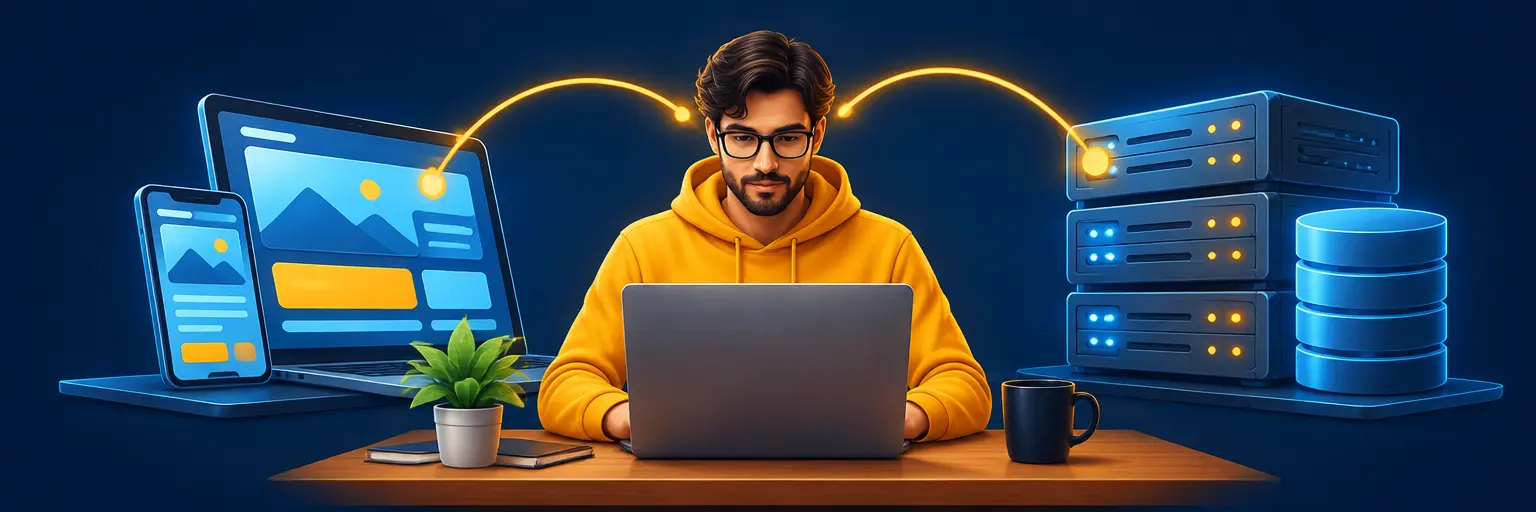
Full-stack JavaScript isn’t just a skill—it’s your passport to building complete, dynamic web applications from scratch. With a single language powering both the client (what users see and interact with) and the server (the logic, data, and security behind the scenes), you simplify your workflow, reduce context-switching, and accelerate your path from idea to deployed product. This introductory guide breaks down the essential roles of front-end and back-end code, demystifies how they communicate via APIs and HTTP, and sets you up with a clear mental model of the Node.js ecosystem—including Express, MongoDB, and modern ES6+ syntax. Whether you’re a beginner taking your first steps or a developer looking to consolidate your knowledge, you’ll finish with the confidence to tackle real-world projects, troubleshoot like a pro, and unlock the full power of JavaScript across the entire stack. Start here to turn scattered snippets into a cohesive, production-ready mindset.

🤔 Master full-stack JavaScript development and learn to scale JavaScript applications efficiently. Our tutorials empower you to build robust, scalable applications ready…
Read article
🤔 Master secure JavaScript applications! This JavaScript user permission tutorial simplifies full-stack authorization, guiding you step-by-step through managing user permissions with practical…
Read articleWelcome to the gateway of modern web development! This subcategory demystifies the powerful combination of JavaScript on both the browser (client) and the backend (server). Whether you’re a coding newbie or brushing up your skills, you’ll learn how one language powers the entire stack. Expect practical insights into Node.js, Express, DOM manipulation, APIs, and real-world project workflows. By the end, you’ll confidently build and deploy dynamic applications, positioning yourself for high-demand roles in tech.
Here, you’ll grasp the fundamental flow of data between a user’s browser and a remote server. We break down HTTP requests, responses, and how JavaScript orchestrates both sides. You’ll explore frontend rendering (DOM) and backend logic (Node.js) without juggling multiple languages. This foundation is crucial for debugging, optimizing performance, and scaling your apps.
Expect hands-on examples showing a simple “Hello World” app that communicates client-server in real time. We’ll compare traditional server-rendered pages with modern SPAs (Single-Page Applications), highlighting where each shines. By mastering this, you’ll avoid common pitfalls like mixed-content errors and CORS issues, making your development smoother and more professional.
This section is your practical launchpad. You’ll install Node.js, initialize a project with npm, and scaffold an Express server from scratch. We guide you through folder structures (public, views, routes) and middlewares, ensuring you understand every line of code. No more copy-pasting blindly—you’ll know why each dependency exists.
Learn to serve static files, handle URL parameters, and manage JSON responses. We also cover environment variables for secure configuration. With these skills, you’ll create a local development server for testing APIs and frontend builds, a step that every serious JavaScript developer must own. This setup is the backbone for all future full-stack projects.
APIs are the glue of full-stack apps, and here you’ll become fluent in both building and consuming them. We’ll design REST endpoints (GET, POST, PUT, DELETE) using Express, then call them from the client using modern fetch or the popular Axios library. You’ll handle asynchronous operations with async/await, manage loading states, and gracefully handle errors.
Practical projects include a mini task manager where the frontend adds, edits, and deletes tasks via API calls. We also tackle data validation and response status codes, ensuring your APIs are robust. After this, you’ll be comfortable connecting any frontend framework (React, Vue) to your own or third-party APIs with confidence.
No full-stack app is complete without persistence. Here, you’ll integrate MongoDB, a NoSQL database, using Mongoose for schema modeling. We’ll create models, run CRUD operations, and link them to your Express routes. You’ll see how data flows from the browser, through your server, and into the database—and back again.
This section includes seed data setup, query filtering, and updating records. We also discuss connection pooling and error handling to prevent downtime. By the end, you’ll build a complete note-taking app with user-created notes stored securely in MongoDB Atlas, preparing you for real-world backend development with JavaScript.
Security is non-negotiable, and this module teaches you the essentials: password hashing (bcrypt), session management, and JWT (JSON Web Tokens). You’ll implement signup, login, and logout flows, protecting routes on both client and server sides. We also cover best practices for sanitizing user input and preventing SQL injection or XSS attacks.
You’ll deploy a demo app where only authenticated users can access certain features. We’ll explain how tokens are stored (localStorage vs. cookies) and their trade-offs. After this, you can confidently secure your applications, which is a top skill employers look for in full-stack developers.
Bring your app to the world! This section guides you through deploying both client and server to platforms like Vercel, Netlify, or Heroku (or Render). We’ll cover environment variable setup, build processes, and serving your Express API alongside your static frontend. You’ll learn to monitor logs and fix common production issues.
Performance tips include caching static assets, using gzip compression, and optimizing database queries. We also introduce basic load testing and refactoring bottlenecks. By the end, you’ll have a live URL to share, demonstrating a complete full-stack JavaScript application—an essential portfolio piece for job applications.
Yes, basic JavaScript syntax (variables, functions, loops) is assumed. We recommend completing our beginner JavaScript tutorials first. However, each concept here is explained step-by-step, and you can learn as you build projects. Focus on understanding the flow, not memorizing every method.
Client-side runs in the browser, controlling the UI and user interactions. Server-side runs on a server (Node.js), handling data, authentication, and business logic. Both use the same language but have different environments and APIs. This subcategory bridges both, allowing you to write one language across your entire stack.
Absolutely. By the end, you’ll build a full-featured note-taking app with user authentication, CRUD operations, and deployment. You’ll also have a robust understanding of how to structure larger projects. The practical exercises mirror real job tasks, giving you portfolio-ready evidence of your skills.
Most learners finish in 3–4 weeks, studying about 5 hours per week. However, pace depends on your availability. The content is modular, so you can revisit sections. We recommend coding along with each tutorial and attempting the mini-projects for deeper retention.
Yes, absolutely. This subcategory focuses on vanilla JavaScript and Express for clarity, but the principles apply directly to React, Vue, or Angular. Once you master the client-server flow, you can easily integrate these frameworks as your frontend, using the same API endpoints you’ve built here.